- Afrikaans
- Albanian
- Amharic
- Arabic
- Azerbaijani
- Belarusian
- Bulgarian
- Croatian
- Czech
- Danish
- Dutch
- English
- Estonian
- Finnish
- French
- German
- Greek
- Hungarian
- Indonesian
- Italian
- Japanese
- Javanese
- Korean
- Latvian
- Lithuanian
- Macedonian
- Malay
- Maltese
- Nepali
- Norwegian
- Persian
- Polish
- Portuguese
- Romanian
- Russian
- Serbian
- Sinhala
- Slovak
- Slovenian
- Spanish
- Swahili
- Swedish
- Tagalog
- Tamil
- Thai
- Turkish
- Ukrainian
- Urdu
- Uzbek
- Vietnamese

The Strength of a Millimeter: The Past and Present of Iron Wire Nail
In architecture, handmade crafts, and daily life, the unremarkable Iron Wire Nail is like a tiny but indispensable "architectural language", connecting everything with its tough body. This seemingly ordinary metal product carries the crystallization of human wisdom for thousands of years, and continues to play an important role in the long river of history with its unique form and function.
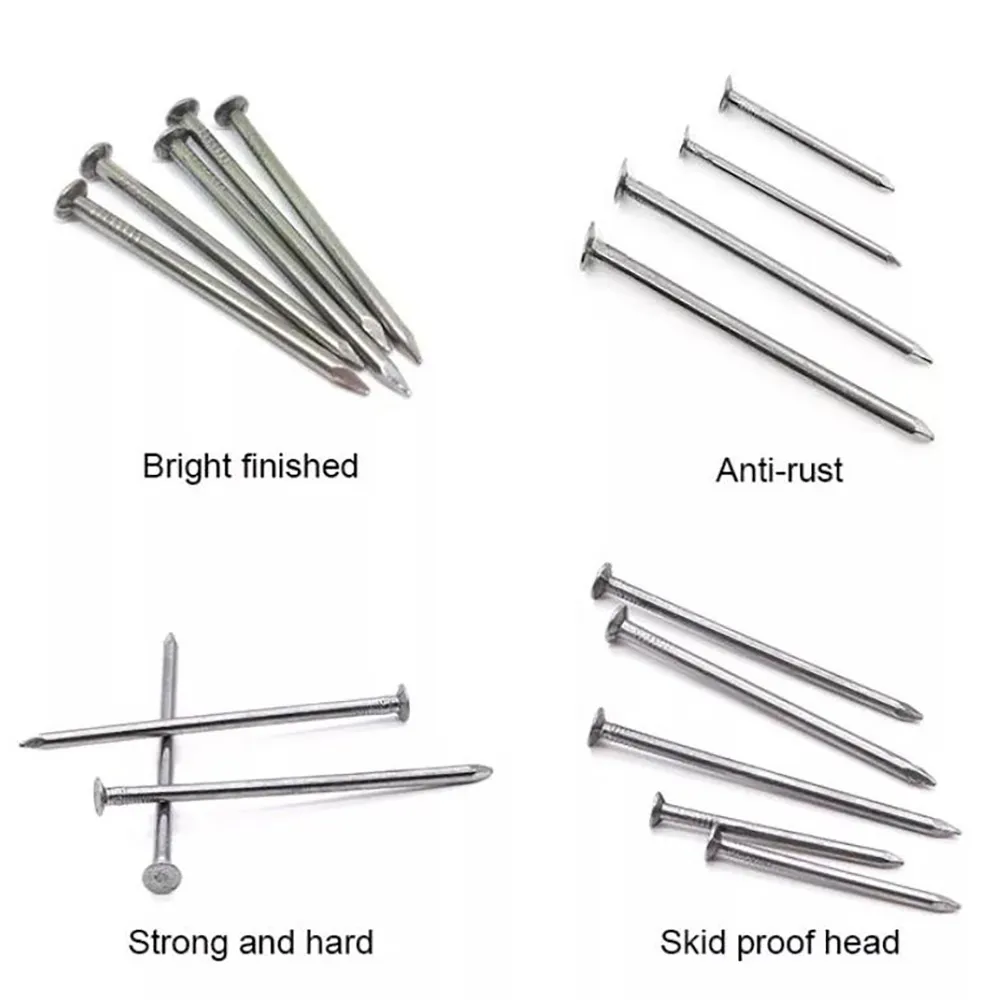
The birth and development of Iron Wire Nail is a microcosm of technological innovation
Early iron nails were mostly hand forged by blacksmiths, requiring repeated heating and pounding, which consumed a lot of time and manpower. With the arrival of the Industrial Revolution, machine manufacturing technology enabled iron nail production to be scaled up. Modern Iron Wire Nail production usually uses low-carbon steel wire as raw material and is completed through multiple processes such as wire drawing, nail making, annealing, and galvanizing. The wire drawing process pulls the steel wire to the desired diameter, and the nail making machine cuts and shapes it to give the iron nail a sharp head and a smooth nail body; Annealing treatment enhances the toughness of iron nails, while galvanizing process effectively improves their rust prevention ability, ensuring their service life in various environments.
The performance advantages of Iron Wire Nail make it a reliable choice in many fields
With high strength and toughness, it can easily penetrate materials such as wood and thin metal, firmly connecting objects. In construction, iron nails work closely together to build a sturdy frame for houses and bridges. Its specifications are diverse, ranging from a few millimeters of mini nails to over ten centimeters of long iron nails, meeting the needs of different scenarios. In addition, advances in surface treatment processes such as hot-dip galvanizing and copper plating have enabled black iron nails to maintain stable performance in harsh environments such as humidity and acidity, effectively extending their service life.
From ancient wooden houses to modern skyscrapers, the application of Iron Wire Nail runs through the history of human construction
In the field of architecture, it is the core material for connecting wooden structures. Whether it is installing doors and windows, fixing templates, or making furniture, the stabilizing effect of galvanized iron nail is indispensable; In handmade and artistic creation, fine iron nails can be used for collage art and model building, providing infinite possibilities for creators; In daily life, Iron Wire Nail is also a reliable assistant for home maintenance and item hanging. A painting or a storage rack can find a place to stay because of it. Even in industrial production, Iron Wire Nail plays an indispensable role as an important connector for assembling small components.
Faced with the impact of new materials and technologies, Iron Wire Nail is also constantly seeking breakthroughs
The research and development of environmentally friendly coating materials has reduced pollution emissions during the production process, making Iron Wire Nail more in line with the concept of green development; The application of special alloy materials endows iron nails with special properties such as high temperature resistance and corrosion resistance, making them suitable for high-end fields such as aerospace and chemical engineering; The combination of 3D printing technology and intelligent production equipment promotes the development of Iron Wire Nail production towards personalization and customization, meeting the special needs of different customers.
Although small, iron wire nails contain powerful connecting power and infinite possibilities. From traditional manual forging to modern intelligent production, it adapts to the needs of the times with a constantly innovative attitude. Whether it's ancient buildings carrying historical memories or modern engineering projects full of technological sense, Iron Wire Nail always sticks to its position, interpreting the value of "small objects, big effects" with resilience and reliability. In the future, with the continuous advancement of technology, this tiny metal product will surely shine in more fields and write a new chapter of its own.
Iron Wire Nail FAQs
What is the main purpose of Iron Wire Nail?
Iron Wire Nail is commonly used in woodworking, construction, and furniture making to secure wood or other materials. Its slender design and metal material provide excellent support and durability.
What are the common specifications of Iron Wire Nail?
Iron Wire Nails come in various specifications, with common lengths ranging from 1 centimeter to 15 centimeters and diameters ranging from approximately 0.5 millimeters to 3 millimeters depending on the application. When selecting, it is necessary to match according to actual needs.
How to prevent Iron Wire Nail from rusting?
Galvanized or coated Iron Wire Nail can be used to enhance rust prevention performance. If the environment is humid, it is recommended to use stainless steel nails or apply rust proof oil after use.
What is the difference between Iron Wire Nail and regular steel nails?
Iron Wire Nail is usually thinner and more flexible, suitable for fine work; Ordinary steel nails are thicker and harder, with stronger load-bearing capacity. In addition, Iron Wire Nails are mostly made of low-carbon steel, while steel nails may be made of high carbon steel.
What should be noted when using Iron Wire Nail?
Avoid excessive tapping that may cause bending or breakage;
It is recommended to drill holes in advance before using on hardwood;
Choose the appropriate nail length based on the material thickness to prevent penetration or weak fixation.
-
Professional Guide to Choosing Nails for Wooden Fence PanelsNewsApr.16,2026
-
PING HONGLIN WIRE MESH CO.,LTD: African Clients Visit Factory, Deepen Cooperation to Build a Global Quality BenchmarkNewsApr.14,2026
-
Guide to Choosing the Best nails for wood trim for CarpentryNewsApr.09,2026
-
Recognized for Excellence: ANPING HONGLIN WIRE MESH Named Alibaba FY2026 TOP Transaction Merchant, Celebrating 35 Years of Manufacturing HeritageNewsApr.07,2026
-
HONGLIN WIRE MESH Showcases at WORLDBEX Philippines 2026, Earning Strong Recognition from Global Builders & DistributorsNewsApr.07,2026
-
Spanish Client Delegation Visits Our Factory for Exchange, Exploring New Cooperation Opportunities in Welded Wire ProductsNewsApr.07,2026


